AWS Services
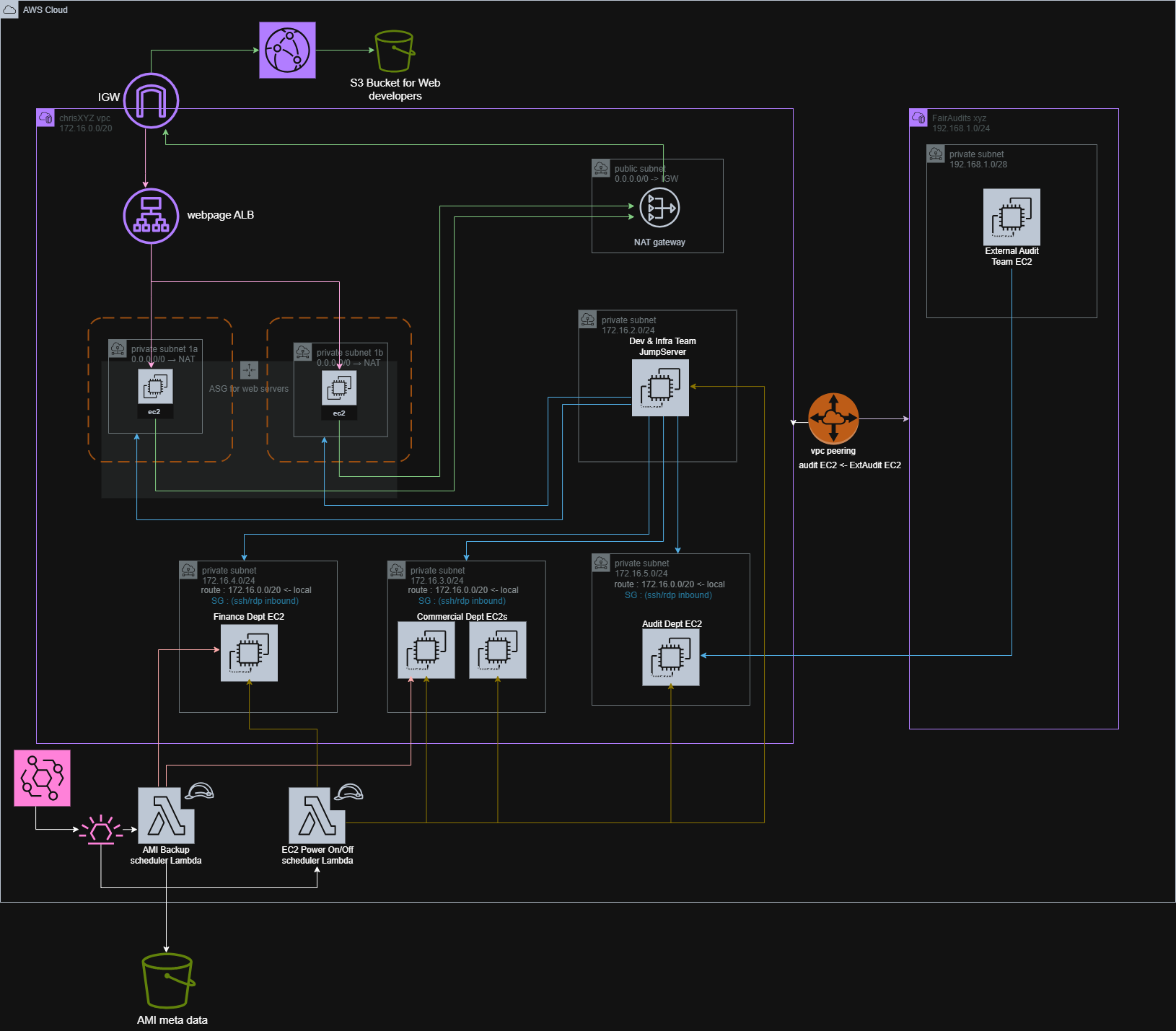
Amazon VPC – Implemented as the core networking layer, including custom VPCs with
public and private subnets, route tables, Internet Gateway, NAT Gateway, security groups,
and VPC peering connections to enable secure communication between isolated VPCs.
Amazon EC2 – Used to host application and utility workloads within private subnets,
ensuring no direct internet exposure.
Application Load Balancer (ALB) – Configured to handle inbound HTTP/HTTPS traffic,
perform health checks, and distribute requests across EC2 instances in multiple Availability Zones.
Auto Scaling Group (ASG) – Implemented to automatically manage EC2 instance scaling
and replacement for high availability and resilience.
AWS Lambda – Used to run serverless automation tasks without provisioning servers,
triggered by scheduled and event-based workflows.
Amazon EventBridge – Implemented to trigger AWS Lambda functions based on scheduled
rules and events, enabling automated operations.
Amazon S3 – Used to store static content, project assets, logs, and artifacts
required by the environment.
Amazon CloudFront – Implemented as a content delivery network in front of S3 to
securely distribute static content with low latency and improved performance.
AWS IAM – Used for identity and access management, including IAM users, roles,
policies, and instance profiles, enforcing least-privilege access across services.
AWS Systems Manager (SSM) – Implemented to provide secure, agent-based
administrative access to EC2 instances using Session Manager, eliminating SSH and public IP usage.
Amazon CloudWatch – Used for monitoring metrics, logs, alarms, and operational
visibility across EC2, ALB, Lambda, and Auto Scaling components.